What Are AI Agents? How Agentic Systems Work in Practice
Published March 15, 2026 by Joel Thyberg
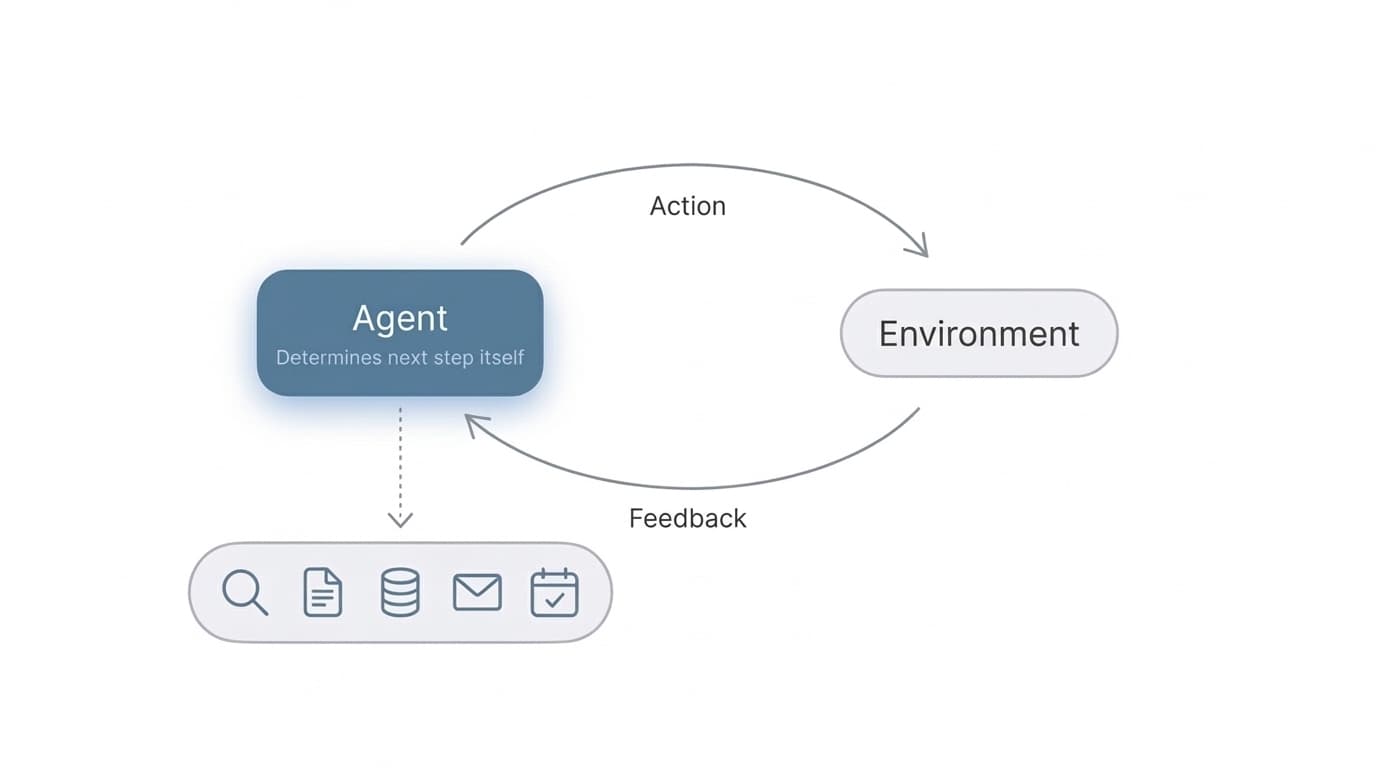
AI agents are one of the most talked-about areas in modern AI, but the term is often used too broadly. In practice, an agent is not just a chatbot with better prompts. An agent is a system that gets a goal, access to tools, some form of memory, and the freedom to choose the next step more dynamically than a normal workflow.
If you first want to compare with more controlled solutions, we also have a guide to AI automation and workflows. Here, the focus is on how agents work technically, why they behave differently from workflows, and which building blocks determine whether they work well in practice.
What Is an AI Agent?
A useful definition is that an AI agent is a goal-directed system where a language model dynamically chooses actions across multiple steps. The agent gets a task, reads its situation, decides what should happen next, uses tools when needed, evaluates the outcome, and continues until the task is complete or handed over to a human.
That means the agent does not just produce text. It can choose among several possible next steps, use tools and external systems, keep track of relevant state during the task, change plan when new information arrives, and decide when to stop, ask, or escalate. It is precisely the combination of goal, loop, and tool use that makes agentic systems behave differently from a normal single LLM call.
The agent's core loop
Goal, observation, action, evaluation
1. Goal
What should be achieved, which rules apply, and when should the agent stop?
2. Observation
What does the agent know right now from prompt, tools, history, and environment?
3. Action
Write a response, call a tool, fetch data, re-plan, or ask for more input.
4. Evaluation
Did things improve, is the result good enough, or is another iteration needed?

What Makes an Agent an Agent
There are a few building blocks that almost always show up in agentic systems. First, a clear goal is required. The agent needs to know what should be achieved, what counts as done, and which constraints apply. Without that, behavior quickly becomes messy, because the model gets too much freedom to interpret what the task really is.
Then you need tools, memory, and feedback. Tools let the agent do more than write text. Memory lets it keep track of history, intermediate results, and sometimes previous similar runs. Feedback lets it observe the outcome of its actions and adjust the next step. It is only when these parts work together that agent systems become practically useful.
If a system just takes a prompt and returns a response once, then it is usually not an agent in the real sense. Agentic systems only become relevant when there is a loop, a goal, and some degree of self-directed next-step choice.
Tools Are What Make the Agent Useful
An agent without tools is often just an advanced text generator. It is only when the agent can act outside its own text window that it becomes practically useful.
That can mean searching internal documents or RAG systems, reading and writing databases, calling APIs to CRM or ticketing systems, running code, doing calculations, or handling files and web pages. As soon as an agent gets those capabilities, it moves from merely reasoning about the world to actually influencing it.

Tool use
The agent becomes a system, not just a prompt
When an agent gets access to tools, it can fetch information, execute actions, and check its assumptions. This is also where boundaries, logging, and approvals become important. Read access is different from write access, tools should be clearly scoped, and many agent failures happen in the interaction between tools, data, and timing, not just inside the model itself.
Memory and Learning, Without Changing the Language Model
This is one of the most important points to clarify. When people say that an agent "remembers" or "learns", it usually does not mean the language model itself is retrained or that the model weights are changing.
In practice, agent memory is more often split into three layers. Working memory is the current history, context, and intermediate results in the ongoing task. Task memory is saved notes, plans, or state that the agent can read later in the same process. Long-term memory is files, databases, vector indexes, or logs from previous similar tasks.
That means learning in practice often looks like a cycle where the agent tries a step, observes what worked or failed, stores the result externally, and then uses that stored information as support next time. It is therefore more accurate to say that the agent uses past experience through stored data than that the language model rewrites itself in real time.
Conversational Agents and Autonomous Agents
Not all agents work the same way. A simple and useful distinction is the one between conversational agents and autonomous agents.
Conversational agents
Conversational agents are started when a human writes or says something. They often work through dialogue, ask clarifying questions along the way, and fit situations where human interaction is a central part of the process. This is common in support, copilots, and analysis-heavy interfaces where the human stays close to the decision.
Autonomous agents
Autonomous agents are more often started by a trigger, a schedule, or an event and then work for longer without direct human involvement. That means they also need clearer rules for tools, stop conditions, logging, and escalation. They appear more often in background processes, monitoring, and more independent workflows.
In real systems there is often a mix. An agent can be started by a human, work autonomously across several steps, and then return for approval before the final action is taken.
The Right Amount of Information Is Critical
Agents rarely become better than the information they are allowed to work with. Too little information means the agent misses important facts, misreads the situation, or gets too narrow a picture of the problem. Too much information can overload the context, dilute what matters, and lead to worse decisions.
This ties directly to the context window. If you want to understand why too much text, too many documents, or too much history can become a problem, read our guide to the context window and context management.
Too little
The agent lacks background, rules, or data and therefore struggles to choose the right next step.
Balance
The agent gets exactly the information the task requires, ordered correctly and clearly prioritized.
Too much
The agent gets irrelevant or overly large context, which can reduce focus, raise cost, and in the worst case contribute to context rot.
Good agent systems therefore work actively with selection, compression, prioritization, and context retrieval. It is not enough to simply give the agent more data.
Agents Need Instructions, But Not Overly Narrow Instructions
There is a similar balance in how tightly an agent should be controlled. If the instructions are too vague, the agent becomes inconsistent and hard to trust. If the instructions are too rigid, the agent can become so constrained that it misses important information or skips reasonable steps just to follow the text literally.
Good agent steering therefore combines a clear goal, clear rules for what the agent may and may not do, requirements for when it should ask, verify, or escalate, and still enough freedom to choose order, tools, or sub-steps when the situation requires it. The point is not maximum freedom and not maximum lock-in, but guided flexibility.
Multi-Agent Systems, When Several Agents Work Together
In some systems, one single agent is not enough. Then you build a multi-agent system where several agents, or agent-like components, collaborate.
This often becomes relevant when different roles need to be separated. One component may plan the work, another may retrieve or produce material, a third may review the result, and a fourth may be responsible for tool calls inside a narrower area. The point is not to get as many agents as possible, but to distribute responsibility in a way that makes the system more stable and easier to control.
A common pattern is supervisor and workers, where a higher-level agent breaks down the work and sends sub-tasks to more specialized agent paths. Another is specialized agents, where different agents are responsible for different domains, tools, or decision types. A third is reviewers and executors, where one agent produces, another reviews, and a third decides whether the result should move forward or be rerun.
In practice, there are often clear hierarchies even in more advanced multi-agent systems. It is rarely effective to let many agents talk completely freely with each other without responsibility boundaries. That is why hybrid patterns often emerge, where planning, specialization, and review are combined in the same architecture.
Agent Skills, MCP, and A2A
Three terms show up more and more often in agent discussions, and it is useful to separate them here.
Agent skills are reusable capabilities or work patterns that an agent can use across multiple tasks, for example how it analyzes a case or performs a certain type of check. MCP, Model Context Protocol, is a standardized way to expose tools, resources, and context to models and agents. A2A, Agent-to-Agent, is about how agents can communicate or delegate tasks to each other in a more structured way.
None of that means the model itself is retrained. These are questions of architecture, interfaces, and coordination around the model.
How Do AI Agents Connect to Workflows?
Many real systems are neither completely pure workflows nor completely free agents. Often, there is a larger controlled workflow around the outside, while one or more steps inside the flow are allowed to behave more agentically.
That is also why the comparison with workflows matters so much. If the process can already be described clearly step by step, a regular workflow is often better. If the process instead requires dynamic choices, tool calls, replanning, and continuous judgment, then the agent path becomes relevant.
If you want to understand the more controlled side of that spectrum, read our guide to AI automation and workflows.
Summary
AI agents are not magical autonomous brains. They are goal-directed systems where language models, tools, memory, and rules are combined so that the next step can be chosen more dynamically than in a normal workflow.
For practical use, four things matter most:
- the agent needs the right tools, not just a strong model
- memory and "learning" usually mean stored data outside the model, not that the model weights are being rewritten
- too little or too much context weakens the agent's decisions
- freedom must be balanced with clear rules, logging, and handoff
If you want a more implementation-oriented view, we also have a page on AI agents as a service.