When Is Finetuning Needed? And When Are Prompting or RAG Enough?
Published March 13, 2026 by Joel Thyberg
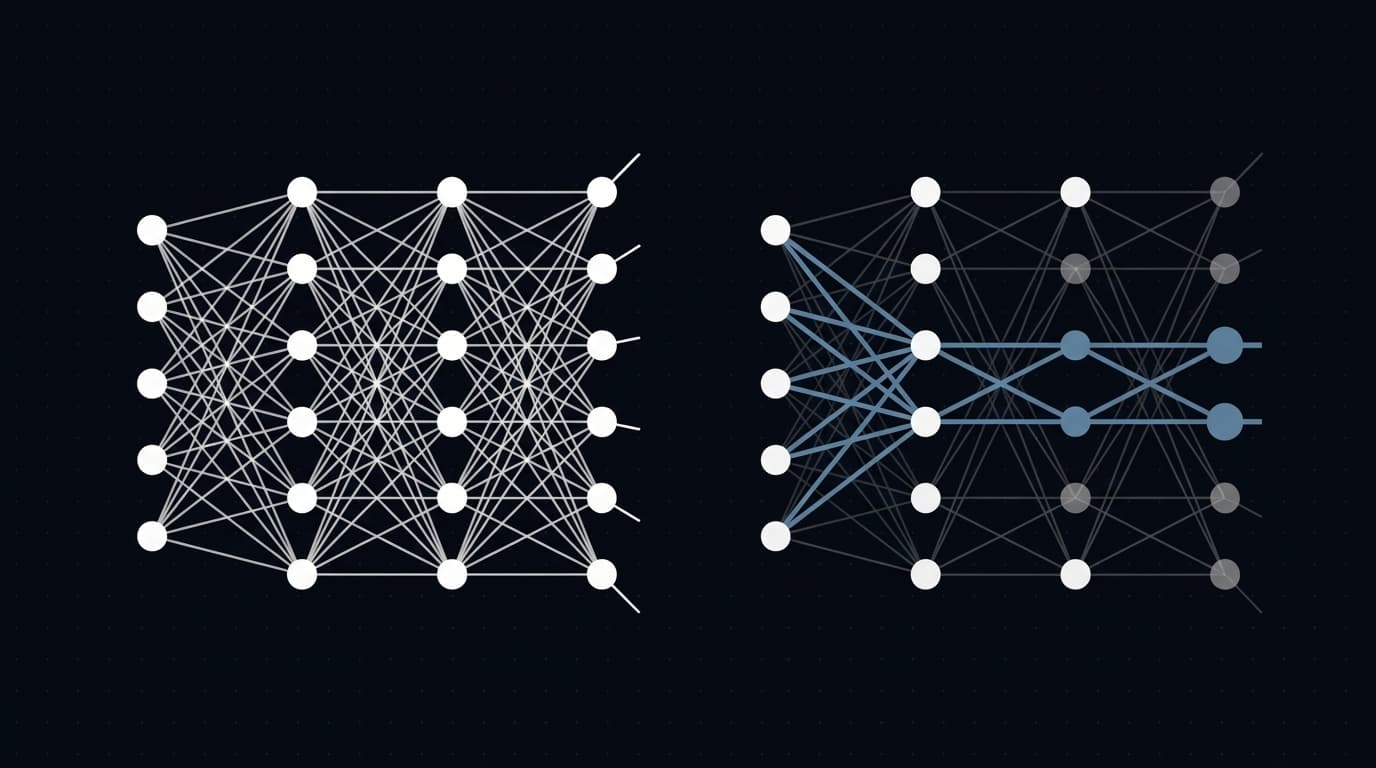
Finetuning is one of the most talked-about words in the AI world, but also one of the most misunderstood. Many people assume it is the standard path when a model needs to become better for a specific business. In practice, it is often the opposite: finetuning is sometimes the right choice, but far from always the first one.
If you want to understand the foundation of how models work, start with our article on language models. Here, the focus is instead on what finetuning actually is, when it helps, and when other setups are usually smarter.
Short answer
Finetuning is needed when you want to change the model's behavior in a more durable and specialized way, not just give it better context.
Why it matters
If you choose the wrong path early, the solution often becomes more expensive and more complex than it needs to be.
Common misconception
That finetuning is required as soon as AI should work with the company's own documents or internal knowledge.
What Is Finetuning?
Finetuning means that you continue training an already existing model on a more specific dataset or toward a more clearly desired behavior. Instead of building a model from scratch, you take a general model and make it better for a narrower use case.
In practice, that can mean the model should write in a certain way, follow instructions more consistently, understand a specific domain language better, or prioritize answers in a way that matches the business more closely. The important thing to understand is that finetuning changes the model's behavior or capability, not only what material it gets access to in the moment.
The Most Common Misunderstanding
One of the most common misunderstandings is that finetuning is needed as soon as you want AI to work with a company's own information. That is often not true.
If the goal is mainly for the model to answer questions about internal documents, instructions, policies, or product information, it is often better to start with a setup that retrieves the right content at question time. That is exactly why solutions like AI with your data and techniques like RAG are so often more relevant than finetuning in the first step.
RAG
RAG is mainly a way to give the model the right material when the question is asked. The focus is on context, search, and access to relevant information.
Finetuning
Finetuning is mainly a way to change how the model behaves. The focus is on specialization, consistency, and more durable behavior in the model itself.
When Are Prompting or RAG Enough?
Before you consider finetuning, you should almost always ask whether the problem can be solved with better instructions, better structure, or better access to the right context.
In many cases, it is enough to work with clearer system prompts, better examples, fixed output formats, validation and business rules around the model, or a setup where the right material is retrieved from relevant data sources when the user asks a question.
That is especially true when the model fundamentally does not lack capability, but rather lacks the right facts at the right moment or receives instructions that are too vague. If the problem is about context, data access, or steering, finetuning often becomes more expensive and more complex than the use case actually requires.
When Finetuning Really Is the Right Path
Finetuning becomes interesting only when you have a more specific need that prompting or RAG does not solve well.
That is often the case when the model consistently needs to answer in a certain format, maintain a specific style, work better in a narrow domain language, or make more precise judgments within a bounded use case. It can also be relevant when you need higher consistency at larger volumes and you actually have enough good data for a change in model behavior to be justified.
Four Common Types of Finetuning
The older technology page discussed several different forms of finetuning. They are still relevant, but fit better here as knowledge than as separate solution pages.
1. Domain adaptation
Here the model is further trained on material from a certain domain, for example law, medicine, technology, or a specific business area. The goal is for the model to better understand the language, concepts, and typical patterns inside that domain.
2. Instruction tuning
Here the focus is less on subject knowledge and more on how the model should respond. Training focuses on getting the model to follow instructions better, produce the right format, and behave more consistently in dialogue or workflows.
3. Preference- or feedback-driven alignment
In some cases, you want to steer the model toward a specific kind of answer quality, tone, or prioritization. Then human feedback or preference data is used to move the model in the desired direction.
4. Parameter-efficient finetuning
Methods like LoRA and other parameter-efficient finetuning approaches make it possible to adapt a model without fully retraining the whole model. That reduces cost and complexity, and is often more realistic in practical projects.
What Does a Finetuning Project Look Like?
A good finetuning project rarely starts in the model. It starts in the use case.
A reasonable process often looks like this:
- Define exactly which behavior or result should improve.
- Decide whether the problem really requires finetuning or whether prompting, RAG, or workflow logic is enough.
- Gather or create a dataset that actually represents the desired behavior.
- Choose training method, evaluation criteria, and target outcome.
- Test the model against real scenarios and compare it to the baseline.
- Make sure operations, monitoring, and versioning work over time.
The hardest part is often not the training itself, but getting the right data and the right evaluation.
What Is Required for Finetuning to Go Well?
For finetuning to create real value, you normally need more than just ambition.
You almost always need a clearly bounded use case, relevant and sufficiently good training data, a reasonable baseline to compare against, and a clear way to evaluate whether the model actually became better. Beyond that, you also need a plan for how the model will be used, monitored, and updated over time.
If any of those parts are missing, the result often becomes harder to trust even if the training technically works.
When Finetuning Is Not Worth It
Finetuning is rarely the right first choice when the problem is really about access to the right information, when the use case is still unclear, or when the training data is small, inconsistent, or low quality. It is also not a particularly good first step if a standard model already performs well enough with proper prompting, or if you need fast iteration with low complexity in the beginning.
That is why many successful AI projects start with simpler solutions and only later decide whether finetuning is actually justified.
A Practical Rule of Thumb
If the question is "How do we get the model to know more about our documents?" you rarely start with finetuning.
If the question is "How do we get the model to behave in a more specialized, consistent, or domain-adapted way?" then finetuning may be relevant.
That difference is often decisive.
Conclusion
Finetuning is powerful, but it is not the default solution for everything. It is best viewed as a specialist tool for specific problems, not as the first step in every AI initiative.
For many businesses, it is smarter to first clarify whether the real need is better context and data access, clearer instructions, more robust workflows, or better integration between the model and business logic. Only when that is not enough is it time to seriously evaluate finetuning.